
La humanidad del héroe / The humanity of the hero
Esta vez no se pudo / This time it wasn't possible

(Note to english - speaking readers: you will find the translated version of this article below the original Spanish one.)
Y con la resaca a cuestas
vuelve el pobre a su pobreza,
vuelve el rico a su riqueza
y el señor cura a sus misas.
Se despertó el bien y el mal
la pobre vuelve al portal,
la rica vuelve al rosal,
y el avaro a las divisas.
Se acabó,
el sol nos dice que llegó el final,
por una noche se olvidó
que cada uno es cada cual.
Vamos bajando la cuesta
que arriba en mi calle
se acabó la fiesta.
Fragmento de “Fiesta”, de Joan Manuel Serrat
Ayer terminó el Mundial.
La previsible victoria de una elegante, joven y metódica selección española sobre un equipo argentino proveniente triunfos tan agónicos como desgastantes, cerró el mayor evento deportivo del planeta. Y no sólo en Argentina sino en muchos otros países, se percibe en el aire una sensación de fin de fiesta tan brillantemente descrito por (ironías de la vida) un español.
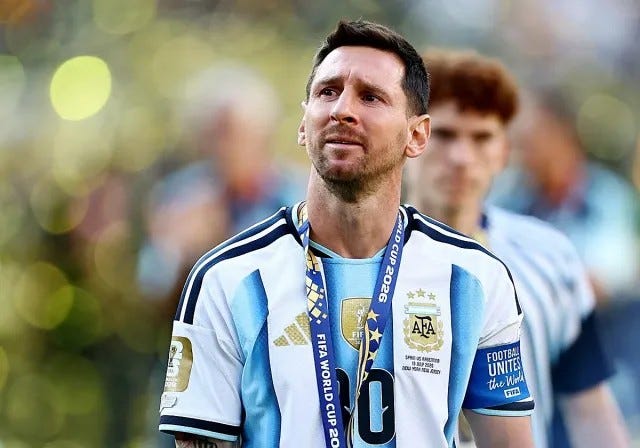
Nacionalidad o preferencias de lado, todo amante del fútbol en particular y del deporte en general seguramente habrá experimentado un dejo de nostalgia al ver la imagen de un Messi solo, en silencio y bañado en lágrimas, que con la final ya consumada comenzaba a sentir en los huesos que muy probablemente su participación en mundiales había terminado. Esta vez no se pudo. A diferencia de los partidos anteriores, no hubo conejo que saliera de la galera para posibilitar lo impensado.
Y está bien que sea así. Porque lo únicos héroes que siempre triunfan son los ficcionales. Los de carne y hueso logran proezas, pero también tropiezan. Y terminan acumulando incontables victorias pero más de una derrota. Quizás para enseñarnos que contra el paso del tiempo, no se puede. Que en el camino perdemos velocidad, potencia y precisión, pero ganamos sabiduría para afrontar las limitaciones con templanza y serenidad.
Veo a Messi solo, de pie y mirando a su afición y pienso en Moshé. También solo, de pie y contemplando desde el monte Nevó una Tierra Prometida a la que no iba a entrar, porque el campeón de la justicia y la humildad tuvo su momento de cólera y careció de la paciencia suficiente para seguirle hablando a aquella roca empecinada en no dar agua. Y así como Moshé tuvo que librar su última batalla contra el pueblo de Midián en el que había encontrado refugio y esposa cuando era un fugitivo de Egipto, el Diez de Argentina tuvo que librar la contienda final nada menos frente a la nación que apostó por él cuando en su propia tierra natal fue repudiado por no crecer lo suficientemente rápido. Como el triunfalismo suele producir amnesia, recordemos que hasta hace algunos años gran parte de los aficionados acusaban a Messi de ser “más español que argentino”. De novela.
Pienso también en David, cuyos pecados de juventud lo privaron de emprender la construcción de lo que hubiese sido su obra cúlmine, el Gran Templo. Y que su hijo Shlomó llevó a cabo, para luego en su ancianidad llenar de ídolos el magnífico Santuario. O en Rabí Akiva, que en su afán por encontrar lo divino en tiempos oscuros terminó apoyando al extremista Bar Kojba. Más cerca en el tiempo, viene a mi mente un Ben Gurión que para crear un estado consiguió el apoyo hasta este entonces impensable de sectores religiosos, aunque a fuerza de concesiones y privilegios que hasta hoy en día siguen creando hostilidad y enfrentamientos dentro y fuera de Israel.
Quizás fue simplemente un partido de fútbol en donde ganó el mejor. O tal vez se trató del cierre más épico y humano a la vez de la carrera deportiva de uno de los mejores atletas de toda la historia. Probablemente haya un poco de ambas posibilidades. Lo cierto es que dándolo todo y obteniendo casi todo, Messi nos vino a recordar que D’s hay un solo y probablemente esté demasiado ocupado intentando que no nos matemos entre todos como para favorecer a tal o cual equipo.
Porque si de algo se trata el heroísmo, es de mantenerse íntegro frente a los inevitables traspiés que la vida tarde o temprano nos va a regalar.
Hay una grieta en todo, así es como entra la luz - Leonard Cohen
Nebujim es un newsletter gratuito e independiente, y su objetivo es contribuir al fortalecimiento de la vida judía latinoamericana. Para aportar económicamente a esta meta hacé click aquí si estás en Argentina y aquí si estás fuera de Argentina.
Jonathan Kohan es Cantor Sinagogal, Magíster en Estudios Judaicos y Lic. en Psicología. Trabaja como profesional independiente en Argentina y los Estados Unidos.
Seguinos en Instagram haciendo click aquí
Escucha el podcast de Nebujim sobre pensamiento judío haciendo click aquí
And with the hangover to bear
the poor man returns to his poverty,
the rich man returns to his riches,
and the priest to his mass.
Good and evil have awakened,
the poor woman returns to the doorway,
the rich woman returns to the rosebush,
and the miser to foreign currencies.
It is over,
the sun tells us that the end has arrived,
for one night it was forgotten
that everyone is who they are.
Down the hill we go,
for up on my street
the party is over.
Excerpt from “Fiesta”, by Joan Manuel Serrat
World Cup came to an end.
The predictable victory of an elegant, young, and methodical Spanish team over an Argentine squad coming off victories as agonizing as they were exhausting brought the planet’s biggest sporting event to a close. And not only in Argentina, but in many other countries as well, there is a palpable sense in the air of an end to the party, so brilliantly described by (ironies of life) a Spaniard.
Nationality or preferences aside, any fan of soccer in particular and sports in general will surely have felt a lingering trace of nostalgia upon seeing the image of a lone Messi, silent and bathed in tears, who, with the final already settled, was beginning to feel in his bones that his participation in World Cups had very likely come to an end. This time it wasn’t to be. Unlike in previous matches, there was no rabbit pulled out of a hat to make the unthinkable happen.
And it is right that it should be so. Because the only heroes who always triumph are fictional ones. Those of flesh and bone accomplish great feats, but they also stumble. And they end up accumulating countless victories, but more than a few defeats as well. Perhaps to teach us that one cannot fight against the passage of time. That along the way we lose speed, power, and precision, but we gain the wisdom to face our limitations with composure and serenity.
I see Messi alone, standing and looking at his fans, and I think of Moses. Also alone, standing and contemplating from Mount Nebo a Promised Land he was not going to enter, because the champion of justice and humility had his moment of anger and lacked the patience to keep talking to that rock stubborn enough not to yield water. And just as Moses had to fight his final battle against the people of Midian—where he had found refuge and a wife when he was a fugitive from Egypt—Argentina’s number Ten had to fight the final contest against none other than the nation that bet on him when, in his own homeland, he was rejected for not growing fast enough. Since triumphalism often produces amnesia, let us remember that until a few years ago, many fans accused Messi of being “more Spanish than Argentine.” Out of a novel.
I also think of David, whose youthful sins deprived him of undertaking the construction of what would have been his crowning achievement, the Great Temple. A work that his son Solomon carried out, only to fill the magnificent Sanctuary with idols in his old age. Or Rabbi Akiva, who in his eagerness to find the divine in dark times ended up supporting the extremist Bar Kokhba. Closer to our time, Ben-Gurion comes to mind, who, in order to create a state, secured the previously unthinkable support of religious sectors, albeit through concessions and privileges that continue to breed hostility and conflict both inside and outside Israel to this day.
Perhaps it was simply a football match where the better team won. Or perhaps it was the most epic and human conclusion all at once to the athletic career of one of the greatest athletes in history. It is likely a little bit of both. What is certain is that, by giving everything and obtaining almost everything, Messi came to remind us that G’d is one, and He is probably too busy trying to keep us from killing one another to favor one team over another.
Because if heroism is about anything, it is about remaining whole in the face of the inevitable setbacks that life, sooner or later, will grant us.
“There is a crack in everything, that’s how the light gets in.” — Leonard Cohen
Nebujim is a free and independent newsletter, and its goal is to contribute to the strengthening of Latin American Jewish life. To contribute financially to this goal, click here.
Jonathan Kohan is a Synagogue Cantor, Master in Jewish Studies and a Bachelor in Psychology. He works as a freelancer in Argentina and the United States.
The only hero who never stumbled was Yeshua our messiah. The rest were brave enough to keep trying, so salute to all of them.